The Semantic Layer Is an AI Agent Contract—Not a Speed Booster
The semantic layer should not be merely a configuration layer for BI tools—it must serve as a legally enforceable contract between AI agents and enterprise data. This article examines how ontology-driven modeling establishes trustworthy boundaries—not acceleration—for agentic workflows.
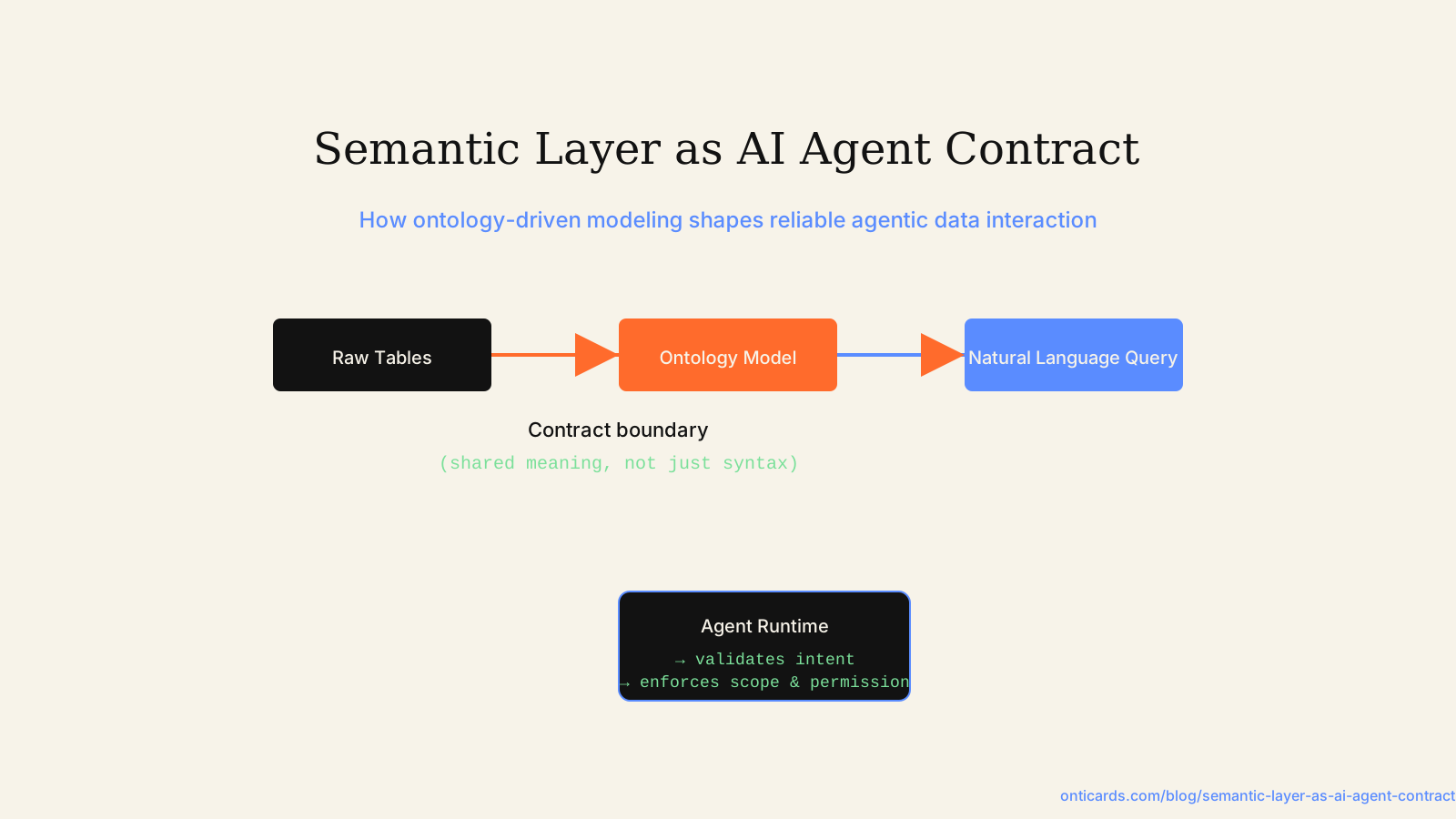
The semantic layer is not a performance booster—it’s a binding contract between AI agents and enterprise data. When organizations deploy AI agents to automate data queries, report generation, or cross-system orchestration, a critical but often overlooked question emerges: Who defines what ‘correct’ means? It’s not about syntactic validity of model output; it’s about whether the agent’s behavior aligns with business intent—consistency of definitions, permission boundaries, temporal constraints, and organizational semantics. We’ve repeatedly observed teams over-investing in fine-tuning large language models for NL2SQL while neglecting the foundational contract layer entirely.
That contract is the semantic layer. It delivers no compute power and generates no SQL directly—but it determines what the agent can see, how it interprets meaning, and what actions it’s authorized to take. At OntiCards, we treat the semantic layer not as a BI configuration tool, but as an executable business semantics contract, machine-readable and runtime-enforceable.
Two Roles, One Layer: Modeling vs. Contract Enforcement
Traditional platforms treat the semantic layer as a frontend mapping layer for BI tools: field renaming, metric formula encapsulation, dimension hierarchy definition. While useful for self-service analytics, this approach fails to support autonomous agent decision-making—because agents don’t read documentation or browse dashboards. They reason and act based on structured semantic interfaces.
A true contract-grade semantic layer must deliver two inseparable capabilities:
- Descriptive power: Express that “sales amount” includes tax under finance definitions but excludes rebates under channel definitions;
- Prescriptive power: Enforce real-time validation before query execution—rejecting intents that fall outside pre-approved semantic domains.
Without description, agents produce ambiguous or incorrect outputs. Without prescription, they bypass permissions or misuse non-authoritative sources.
Why Ontology Modeling Is the Natural Fit for Contracts
Ontologies aren’t new—but in the AI agent era, they’ve regained technical legitimacy. Their value lies not in elegant knowledge graphs, but in explicit, verifiable, composable semantic constraints:
- Classes define entity categories (
Customer,Invoice)—not physical table names;
- Properties bind semantic rules (
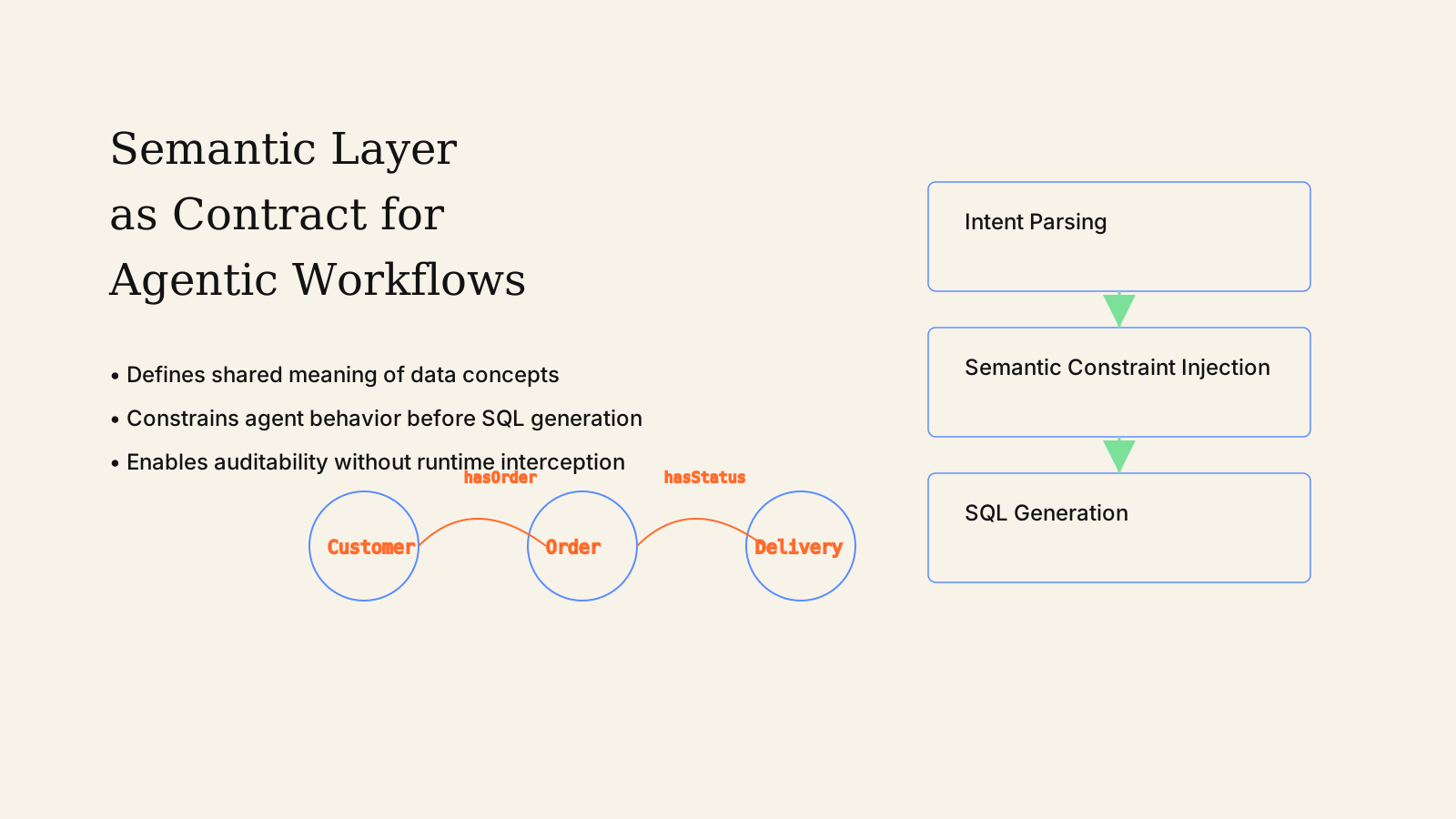
hasEffectiveDatemust lie within[2020-01-01, now]);
- Relations declare valid association paths (
Invoice → Customerpermitted;Invoice → Employeerequires approval flow);
- Constraints use OWL or SHACL expressions—parsed and enforced by runtime engines.
So when an agent asks, “What’s the repeat purchase rate for high-net-worth customers in East China over the last three months?”, the semantic layer intercepts during intent parsing: it flags that “high-net-worth” isn’t defined in the customer taxonomy—or that “repeat purchase rate” isn’t marked as publicly usable in the metrics ontology. This guardrail operates before SQL generation—making it faster and more reliable than post-hoc auditing.
NL2SQL Success Depends on Semantic Anchors—Not Model Size
Most NL2SQL systems suffer from “hallucinatory accuracy”: strong test-set performance, frequent production failures. The root cause is rarely model capacity—it’s the absence of stable semantic anchors.
In manufacturing clients, for example, the same KPI (“output volume”) often diverges across finance and production systems. An NL2SQL model trained only on schema and sample queries may randomly pick either version—without recognizing the business rule: “Use real-time MES values, not ERP monthly archived ones.”
A contract-based semantic layer maps ambiguous natural language to constrained ontology instances. The model then generates only within that narrowed semantic space—dramatically reducing ambiguity. Accuracy gains come primarily from disambiguation at the semantic layer—not from stronger models.
In Sovereign & Private Deployments, Contract Integrity Trumps Performance
In regulated sectors like government and finance, customers demand full traceability, explainability, and auditability for every agent-initiated data access. Low latency or high throughput is meaningless if you cannot prove why a query was allowed—which semantic rule authorized it, and whether permission checks passed.
The semantic layer, as a contract carrier, natively supports three sovereign-compliant capabilities:
- All semantic definitions export in standard RDF/OWL—engine-agnostic;
- Permission policies and data lineage auto-generate from ontology relationships—zero custom code;
- Audit logs embed semantic context (e.g., “Authorized because user role ∈ [Regional Sales Director] AND query scope ⊆ [East China] ontology subclass”).
This makes the semantic layer a neutral protocol layer—connecting domestic databases, BI tools, and AI agents—free from vendor lock-in.
Conclusion: When the Contract Fails, Even the Smartest Agent Becomes a Risk Vector
An AI agent’s value isn’t measured in response speed—it’s measured in whether it always asks the right question first. If the semantic layer degrades into a configuration UI or metric warehouse, it enables intent drift: “revenue” today, “collections” tomorrow, “contract value” the day after—without verifying consistency across a shared semantic framework.
Therefore, the first gate in adopting agentic workflows isn’t model selection or orchestration frameworks—it’s collective alignment: Which semantics are organization-wide consensus? Which constraints are non-negotiable? Which changes require cross-departmental review?
Only when the semantic layer becomes a signed, evolving, machine-readable contract can AI agents evolve from automated executors into trusted collaborators.
References
References
- W3C OWL 2 Web Ontology Language Document Overview: https://www.w3.org/TR/owl2-overview/
- The Semantic Layer: A Critical Component for the Modern Data Stack (dbt Labs, 2023): https://docs.getdbt.com/guides/semantic-layer
- SHACL: Shapes Constraint Language 1.0: https://www.w3.org/TR/shacl/
- What Is a Semantic Contract? (MIT CSAIL, 2022 whitepaper): https://csail.mit.edu/semantic-contract-whitepaper