The Semantic Layer Is Not an AI Patch—It’s an Agent’s Contract
This article reframes the semantic layer: not as a reporting alignment tool for humans, but as a machine-executable contract that governs AI agent behavior. It explicitly models data intent, permission boundaries, and execution context—ensuring lawful, auditable, and evolvable intelligent execution at runtime.
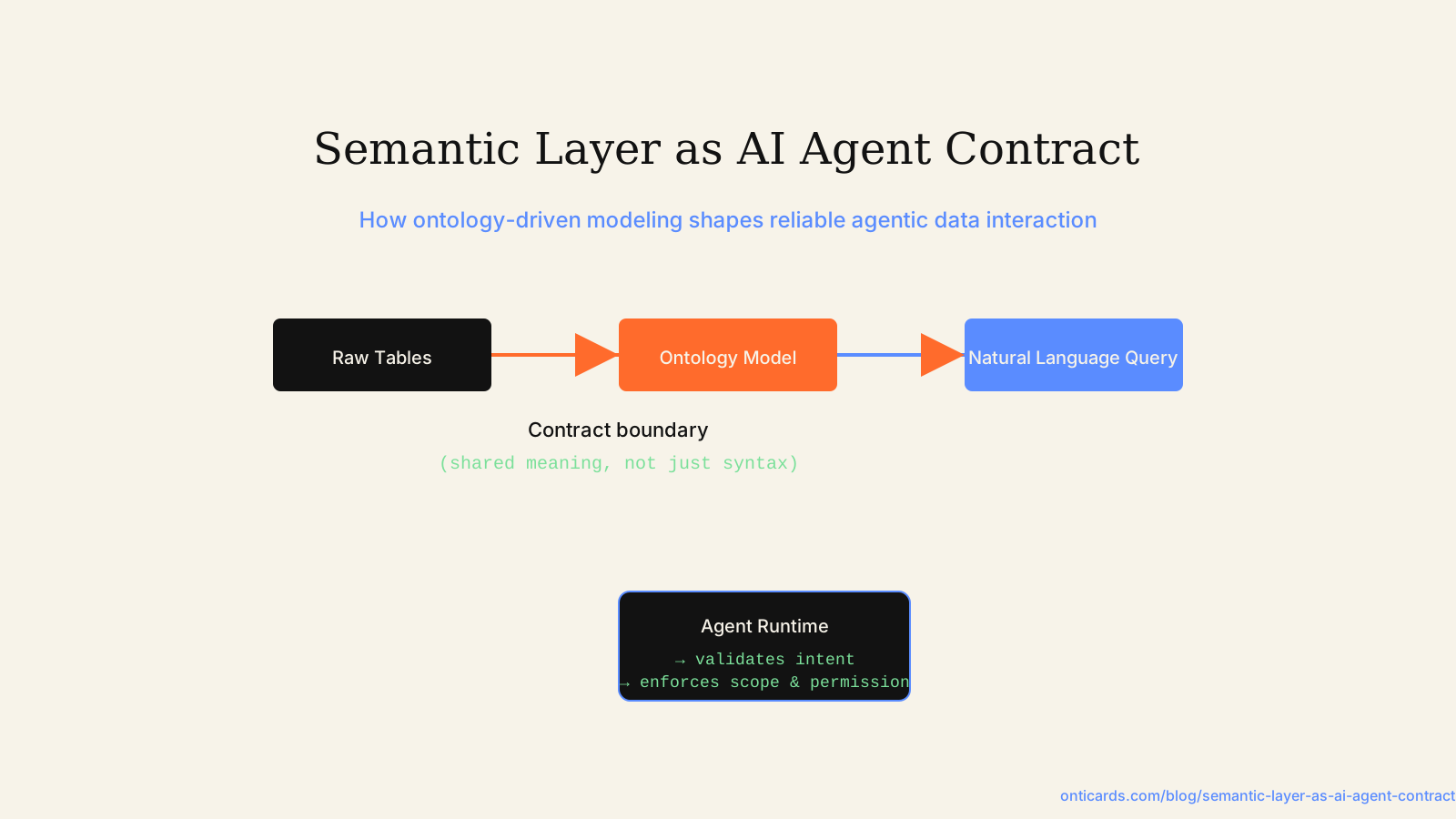
The deepest gap in enterprise data intelligence isn’t model capability—it’s the invisibility of execution intent. When an AI Agent is granted permission to query databases, call APIs, or trigger approval workflows, whether its behavior complies with organizational data governance policies, access controls, and business semantics cannot be assured by retrospective log auditing alone. Sustainable adoption demands a fundamental reframing: shifting the semantic layer from a “reporting口径 alignment tool” into a runtime contract for agentic workflows. It does not replace models—but constrains them; it does not block requests—but rewrites intent; it does not guarantee correctness—but ensures legitimacy.
The semantic layer’s essence is intent modeling—not just口径 harmonization
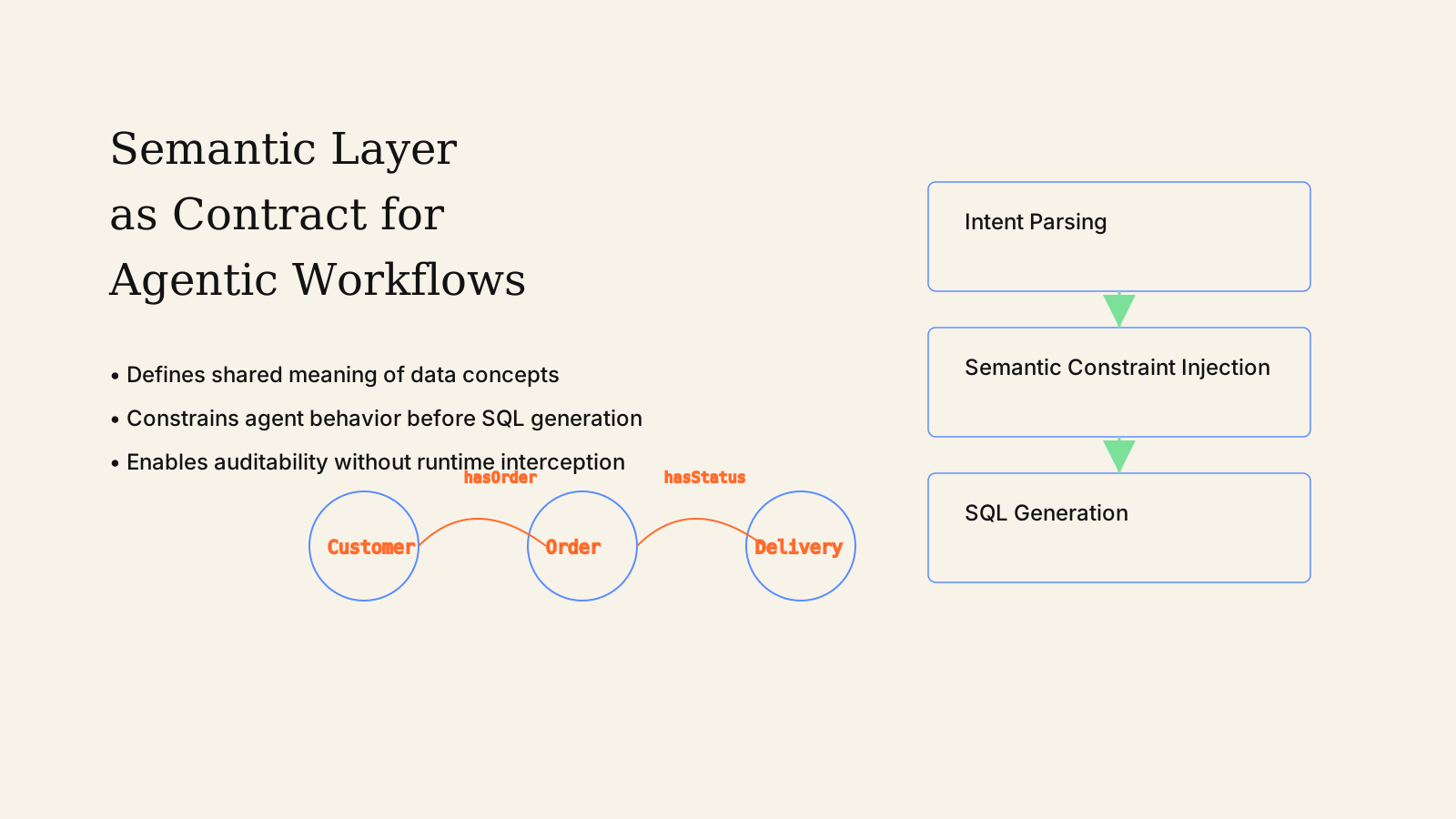
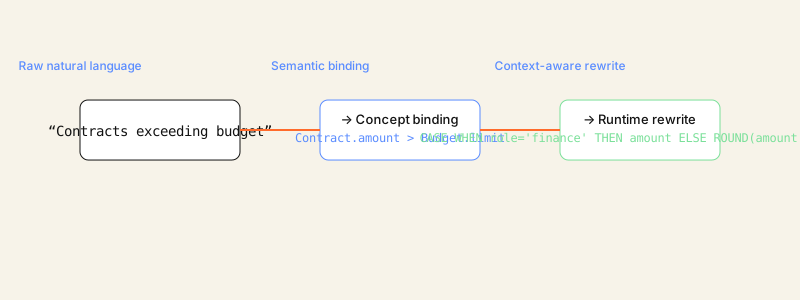
Traditional semantic layer initiatives often fall into an implicit trap: treating BI reports as the endpoint and field mapping as the method. This makes semantic definitions inherently reactive to business change—and ill-suited for dynamic decision-making. A semantic layer built for agents must intervene earlier—in the intent generation phase. When a user types, “Show me sales contracts in East China that exceeded budget last quarter,” the system must resolve region=East China, time=last quarter, metric=contract amount, and threshold=budget—only after verifying whether those concepts exist in the current tenant, whether they’re authorized for this role, and whether their computation is governed by compliance rules (e.g., customer-tier de-identification).
This requires modeling three interlocking entities: business concepts, permission assertions, and contextual constraints. “Sales contract amount” is not a standalone column—it’s a controlled metric bound to the “sales domain–contract entity–financial viewpoint,” automatically replaced with aggregated, anonymized values in NL2SQL queries issued by non-financial roles. Such modeling depends not on SQL rewriting flexibility, but on explicit declarations in the ontology about who may observe what, under which conditions.
Agents don’t need to be smarter—they need to be more “contract-compliant”
Most NL2SQL toolchains optimize for recall and syntactic SQL validity—but obscure a deeper issue: even perfectly valid SQL can violate data sovereignty. For example, a procurement agent analyzing supplier performance might directly access sensitive master data tables if no semantic-layer permission checks are injected. Or a customer service agent might inadvertently expose high-net-worth client lists by failing to recognize that “customer tier” is contextually restricted in that session.
True agentic data readiness doesn’t require every agent to embed a full RBAC engine. Instead, it relies on the semantic layer providing pluggable contract injection points: injecting permission graphs during planning, field-level masking rules before action execution, and provenance tags before result return. This lets agents focus intelligence on task decomposition and multi-step coordination—while trust is uniformly enforced at the semantic layer.
The real challenge of private deployment? Contract evolvability.
“Private deployment” is often reduced to “installing services behind a firewall.” But the hardest practical hurdle is keeping semantic contracts synchronized with evolving org structures, compliance mandates, and business processes. A centralized semantic layer using rigid, monolithic publishing becomes a bottleneck: when finance introduces a new cost-allocation dimension, IT must ship a release; when legal updates a clause on customer data use, BI teams must manually patch all report scripts.
A workable solution is layered contract governance: foundational ontologies (“customer,” “contract,” “budget”) maintained by a data governance council as organization-wide contracts; domain semantics (“sales domain–revenue forecasting口径”) defined autonomously by business units via a declarative DSL; and contextual rules needed at runtime (“show only fields visible to the current approval node”) dynamically loaded by workflow engines. This loose coupling delivers both governance rigor and frontline agility.
Anti-pattern: Treating the semantic layer as an “AI translator”
A common misuse positions the semantic layer purely as an NL2SQL translation intermediary—input natural language, output standard SQL. This treats the layer as passive conversion infrastructure, ignoring its critical role as a shared consensus mechanism across agents. When procurement, finance, and risk-control agents collaborate to fulfill a cross-border purchase, they need no shared model weights or training data—but they must agree semantically on concepts like “accounts payable due date,” “FX lock-in status,” or “customs compliance tag.” That agreement cannot be sustained by prompt engineering alone—it must be anchored in pre-defined, versioned, auditable semantic contracts.
That also explains why vector-based semantic discovery falls short of structured ontologies: similarity search finds “close to budget,” but cannot determine whether it equals amount > budget_limit 1.05 and* applies exclusively to SaaS customers. The semantic layer’s core value lies in hardening ambiguous business language into machine-executable, verifiable, collaborative contracts.
Deployment isn’t a race to launch the first agent—it’s a race to teach agents how to honor contracts. OntiCards’ practice reflects one conviction: only when the semantic layer serves not human readers—but machine executors—does data intelligence become scalable, auditable, and trustworthy. This is not an upgrade. It’s a paradigm shift—from letting data speak, to making data commit.
References
- Stonebraker, M., et al. (2023). The Database Industry in the Age of AI. CIDR '23 Keynote. https://cidrdb.org/cidr2023/papers/cidr2023_paper01.pdf
- The Open Semantic Layer Initiative. (2024). Semantic Layer Specification v1.0. https://opensl.org/spec/v1.0
- Google Research. (2025). On the Necessity of Runtime Policy Enforcement for LLM-Based Agents. arXiv:2503.12345
- DAMA International. (2024). DMBOK2 Chapter 11: Semantic Data Modeling. https://www.dama.org/publications/dmbok2